
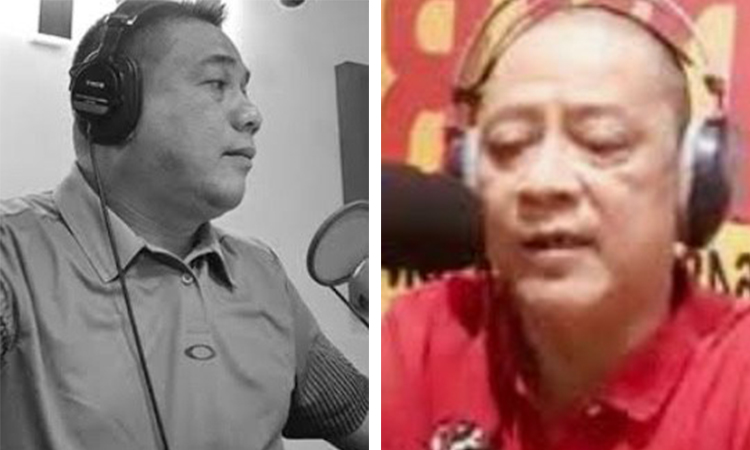
An SITG was activated for each of the 2021 violent attacks against Rey Cortes and Rico Osmeña
November 24, 2022
Related: Update on violent attacks on Cebu journalists in the 2022 List (Category: Killing Journalists), including an entry about Rico Osmena, one of three victims who survived. One of the three, Rey Cortes, was killed in the second assault.
AN SITG or Special Task Force Investigation Group was formed by the police to investigate the Dec. 16, 2021, attempt to kill Rico Osmeña, a DYLA radio block-timer and stringer for the Manila-based “Daily Tribune”.
Osmena survived the attack but still had to recover fully from two .45 caliber gunshot wounds.
The Rico Mirasol Osmeña SITG was set up not right after the day two gunmen shot him while he was riding in a Beep minibus for home after his radio broadcast. The SITG was formally activated only on Feb. 3, 2022, or 49 days after the shooting. And on or about Aug. 3, 2022, or six months after creation, the SITG was disbanded and the “cold case” was turned over to the PNP unit CIDG or Crime Investigation and Detection Group.
What crimes are handled by an SITG? Who forms it, what it does and allied questions the journalist needs to know. It’s information related to the safety of journalists and what the government does when that is compromised. Relatives of a media worker killed, wounded or otherwise assaulted would want to learn how police investigate the crime.
Here are some basics about the SITG:
Who’re covered. Under the PNP’s standard operating procedure #2012-003 of Nov. 12, 2012, the policy is that an SITG shall be “immediately organized” whenever a “sensational or heinous crime transpires.”
The same rules require that the police or station commander immediately assess the “serious crime” on which the assessment district, provincial, or city police director shall base his recommendation to the regional director if there’s a need to “activate” an SITG. “Serious crime” is defined in the memo as “heinous/violent” committed against prominent or controversial personalities.
Media practitioners are included in the list of persons for whom, as victims of violence, an SITG may be formed. Listed in the district, province or city level are vice governors, provincial board members, mayors, vice mayors and city/municipal councilors, barangay captains and councilors, judges, prosecutors and IBP lawyers, militants, media practitioners and foreign nationals.
Advantage of an SITG. The SITG is responsible for “properly managing” the case to “ensure its resolution by applying the best investigative techniques/practices” and “utilizing all available resources.” The managers for the district level include a supervisor, a commander, a spokesman, and among the members: an intelligence officer, a crime lab chief, an inter-agency coordinator/case record officer, an investigator and evidence custodian, and the police chief.
All top officers, with their respective experiences and skills – supported by various teams on investigation, technical, evidence, administration, logistics, legal and public relations – are tasked to solve the crime.
60-day period. The SITG is deactivated once the case is solved or, if after 60 days, it has remained unsolved. Its operation may be extended, but for not more than one month. Once the crime becomes a “cold case,” the CIDG takes over the investigation.
Cortes and Osmeña shootings. Two shootings with broadcasters as victims had benefited from an SITG: the murder of Rey Cortes of DYRB on July 22, 2021, and the wounding of DYLA’s Rico Osmeña on Dec. 16 of the same year. Their respective SITGs, however, were disbanded with the cases still unsolved.
An earlier violent attack against media workers that happened before 2021 was the shooting on Sept. 14, 2013, in which a former radio broadcaster, Jessie Tabanao, was killed. The PNP memo on SITGs was already in force then, but it was not known if an SITG was created to investigate his murder. – Pachico A. Seares