
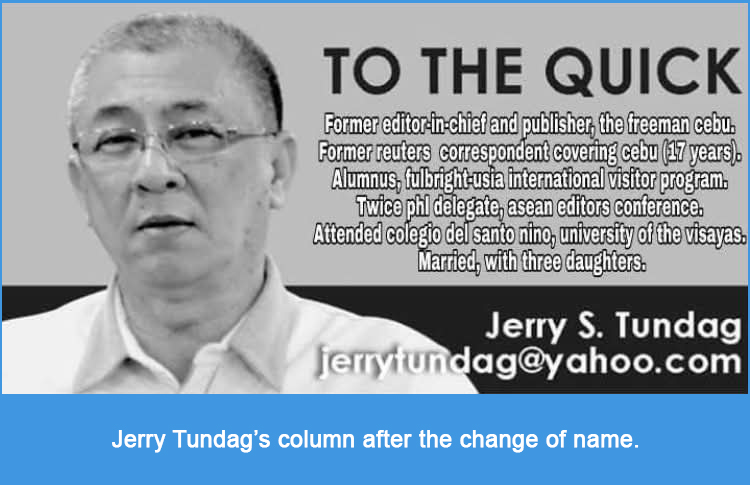
1. ‘Accidental’ journalist Jerry Tundag tells why he changed the name of his column.
Journos’ “I” notebook
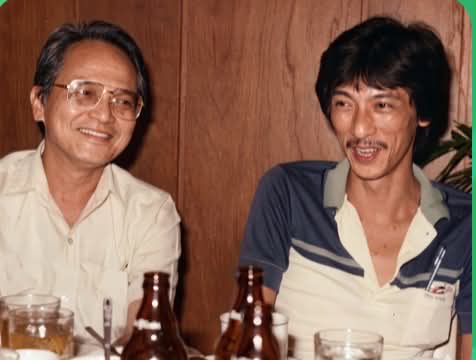
JST (right) named his column “Human Writes,” obviously influenced by his then editor Juanito V. Jabat, who loved punning. Jabat’s column was titled “Have Bat, Will Strike.” JST passed away in 2023 at 70; JVJ in 2015 at 85.
1. ‘Accidental’ journalist Jerry Tundag tells why he changed the name of his column.
From Jerry Tundag’s column in the Freeman, Dec. 9, 2022. Adapted to CJJ May 26, 2026.
Yesterday marked the 40th year since this column was first published on December 8, 1982. I had just joined The Freeman exactly a month earlier as a reporter. I became a journalist by accident nearly two years prior with another paper. It was my editor-in-chief then, Juanito Jabat, who asked me to do a thrice-weekly column, which I still maintain up to this day, four years into my “official” retirement in 2018.
I still remember what Mr. Jabat told me to bolster my confidence when I expressed reluctance in taking on the job: “Jer, columnists do not apply. They are invited.” If the highly-respected veteran Mr. Jabat had that much confidence in a just-starting journalist like me, who am I to refuse? And that started me in this “sideline” career path that has now outlasted my main journalistic profession that ended in retirement after 35 years.
This column originally came by another name, “Human Writes”, inspired in no small measure by the political atmosphere obtaining in the latter part of the Marcos Sr. years, and in part by John Lennon’s collection of scribblings called “In His Own Write”, being a huge Beatles fan. The maiden article set for publication on a December 8, feast of the Immaculate Conception, I wrote that had a slightly religious tone.
But this column went into so many other things after that. I must admit it was through this column that I gained the notice that my main career as a journalist –from reporter to editor-in-chief to publisher– could probably never have given. I made enemies via this column but I also gained even more friends. I have never been sued for libel on account of what I wrote here. And I never won an award either.
I have always refused to submit samples of my work to award-giving bodies, feeling it absurd to be named “best” in an entire given year on the basis of three to five carefully selected “glowing” samples. If I am to be judged fairly, judge me for my entire body of work for an entire year. That way I will be rated in my best moments as well as in my worst. Any writer, after all, has his ups and downs.
There were actually two awards won out of my writing daily editorials for The Freeman, but awards for editorials are institutional, not personal, so they go to the paper. No bragging rights behind the anonymity of editorial writing. One award was given by the Philippine Press Institute-Konrad Adenauer Community Press Awards, the other by the Cebu Archdiocesan Mass Media Awards.
What I lack in awards, though, is more than made up by what people say behind my back about the way I write, and which eventually find their way to my ears in casual, off-the-cuff moments. But the greatest compliment I ever got was when USA Today published in its opinion pages on October 27, 2015 a portion of my column plus a link to the entire article in The Freeman. A friend in Oregon alerted me to it.
I changed this column’s name in 1988 after a daughter died of leukemia before reaching the age of two. I stopped writing for a couple of months. For lack of money to pay hospital bills, The Freeman had run a fund drive for the purpose. The response was heart-warming. It was also mostly anonymous. As this column had largely been hard-hitting, I did not want to hit those who, despite everything I wrote, may have helped me quietly.
I mentioned at the beginning of this article that it was by accident that I became a journalist. Well, not really. I had always wanted to be one. What was accidental was how I got in at the time that I did. Without any formal background or training, I applied for a proofreading job at the Visayan Herald, hoping to learn my way from there. But managing editor Cerge Remonde, because of propitious circumstances, made me a reporter. 
2. The music in Jerry Tundag’s life
From JST’s column in The Freeman, Feb. 9, 2011.
Adapted to CJJ May 26, 2026.
AS usually happens on my dayoff, I start the day early listening to music or end it late doing the same thing. I have a very narrow window of interest when it comes to my personal music. It involves the music of the Sixties and Seventies.
Every now and then, however, I get to pick up a few truly extraordinary and beautiful pieces of music from outside this generational confinement of musical choices. But by and large I am convinced that truly great and meaningful music stopped with my generation
Come to think of it, though, it is not as narrow as two decades worth of music may seem to suggest. The music of the Sixties and Seventies is, on the contrary, quite extensive. This was an era when musical output literally exploded.
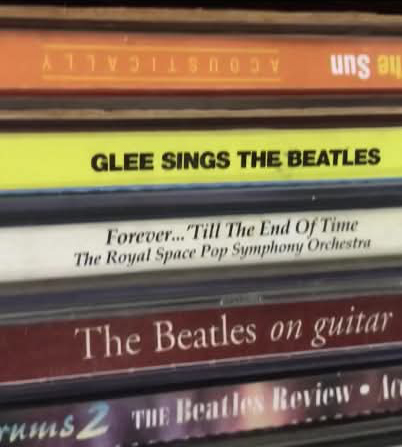
No other era can match the sheer productivity of this period. The Beatles, for example, which typifies this period, and which I am a very great fan of, produced an incredible array of compositions in the seven years (1963-1970) that they were actively together.
The music of The Beatles has in fact gone beyond generational. No other records by any other artist, group or solo, living or dead, can outsell The Beatles over time in any music store today. If you do not believe me, go to a music store and ask.
The music of The Beatles not only continues to be available and to sell, they continue to be played in a wide variety of media even to this day, more than 40 years since they broke up and left a void that is impossible to fill, ever.
There is even a television commercial (I think I saw it on CNN) in which the lyrics of the song “In My Life” by The Beatles is narrated by actor Sean Connery. It is one of the most beautifully-worded songs of The Beatles, and hearing it in this manner is simply moving.
My collection of Sixties and Seventies music is also quite extensive. I take great effort to collect them because I know that, with the exception of The Beatles and a few other notable groups of the era, they are songs that are no longer available conventionally.
That is why one of my favorite pastimes whenever I find myself in a mall is to always visit a music store and just browse around, hoping that, if I get lucky, I can come across some reissued CD of music that I still don’t have. I have been quite lucky to-date.
This week, I ended my dayoff (Monday) late by listening to The Beatles’ very first album “Please Please Me.” And as I always do when listening to music, I simultaneously read over and over again whatever it is that is written on the album cover.
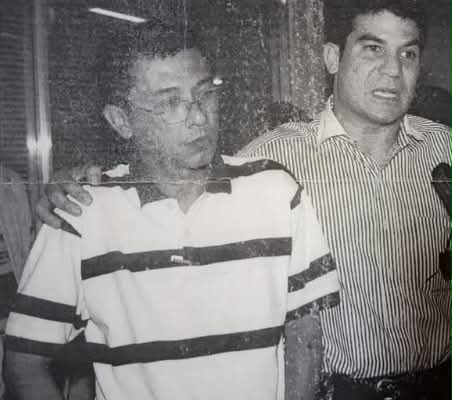
A visiting movie-TV star with Jerry Tundag.
From these readings, I continually make side comments to my wife Arlene, who for whatever reason, has made it a point to stay beside me when I enjoy my music. Maybe she also loves it. Or maybe it is just a precaution, in case I get too carried away by my emotions. Whatever.
Anyway, as I was listening to the “Please Please Me” album, my attention went to the year the album was released, which was 1963. Not that I did not know. It’s just that from time to time, some info you already know just suddenly becomes more interesting now than before.
So I told Arlene: “You know, The Beatles released this album the year before you were born. And here you are, listening to them.” I don’t know if the disclosure meant anything to her, because I suddenly was seized with a new realization.
While The Beatles was formed in 1960 and had their first single “Love Me Do” out in 1962, it was not really until 1963 with the release of “Please Please Me” that the phenomenon the world would call “Beatlemania” would set in.
In other words, the 50th anniversary of “Beatlemania” is just two short years away in 2013. It would have been a great occasion to have a reunion of the “Fab Four.” But of course that will never come to be, ever.
The deaths of John Lennon and George Harrison have shut the door to that possibility forever. But wouldn’t it be great if Paul McCartney and Ringo Starr, the two surviving Beatles, could get together one last time, for the sake of all who have been touched by their music.