
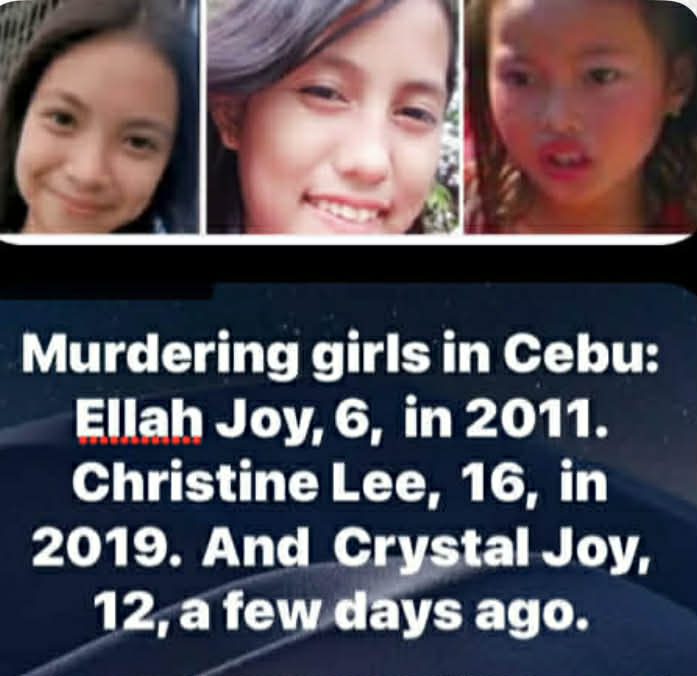
Pubmat on the article connecting three gruesome killings of girls in Cebu, eight and seven years apart.
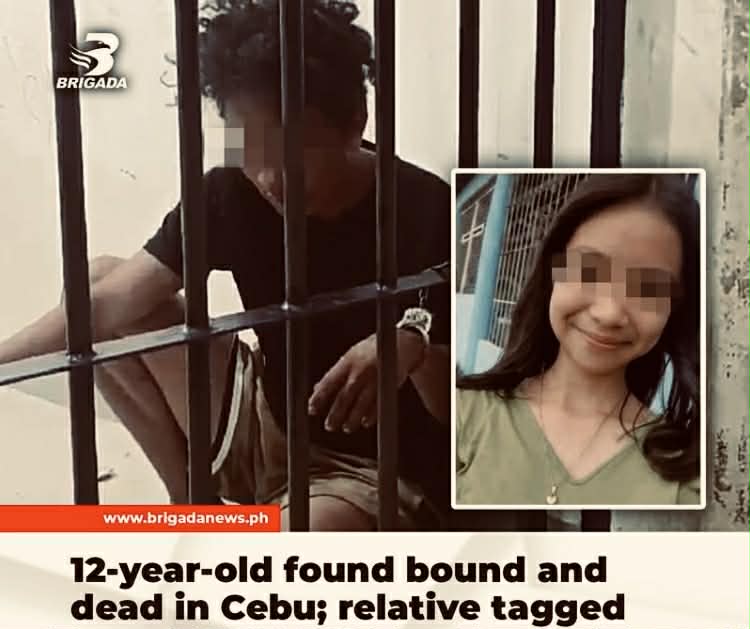
Facebook feed of the news on the February 2026 murder in Toledo City, the most grisly yet: the victim was beheaded. (From Brigada News)
These are no ordinary crimes against persons. Victims are children – ages 6, 12 and 16 – and the manner of killing is brutal, grisly, gruesome.
One had skin scraped off her face. Another had bruises on many parts of the body, signs of beating, and was left naked up to her waist, after the rape. The latest victim (February 2026, in Toledo City) was beheaded and the body tied to a tree, with the severed head dumped nearby.They get more media attention, in the form of time and space, for the understandable large public interest they draw.
They are true crime, for its public appeal but also for the lessons they provide, including the obstacles in catching and prosecuting culprits and public safety reminders, such as not trusting strangers and being cautious with friends or relatives.
THE THREE VICTIMS. They were all minor, still children, yes — ages 6, 12, and 16 — and the three were murdered, eight and seven years apart.
And they had disappeared, one kidnapped or abducted, before they were killed. Brutally, as state of their bodies showed.
The third and latest victim, whose body was found this week in Toledo City, was beheaded and tied to a tree.
Start the list with her:
[1] Crystal Joy Lagaras Abarquez, 12, a Grade 6 student, was found dead Thursday, February 19, 2026, in a forested area of Toledo City. She had disappeared eight days before, i.e. Wednesday, February 11.
Her head was severed and dumped a few meters from a tree in Sitio Pajo, Barangay Cabitoonan (near the boundary with Barangay Ibo). The decomposing body, already “beyond recognition,” was tied to the tree, with a shoelace strung around her neck. Her school bag and other personal belongings were found nearby.
[2] The body of Christine Lee Silawan, 16, a high school student, was dumped on a vacant lot in Lapu-Lapu City. She was found March 11, 2019.
Christine Lee was naked from the waist down. She was raped, which the Public Attorney’s Office forensics test later confirmed. Multiple stab wounds on the body; her face mutilated (“skinned beyond recognition”) by using acid or scraping it with a sharp knife or bladed weapon.
[3] Ellah Joy Pique, 6, of Minglanilla, Cebu was “kidnapped” February 8, 2011, by a white male foreigner and Filipina companion while the grader was walking home with friends from school. She accepted the offer of a ride home from a couple in a Pajero. The following day, she was found dead.
Ellah Joy’s naked body was wrapped, including three big stones, in a white bedsheet and thrown off a cliff in Barili town. She was killed with heavy blows on the head, her upper body showing dark bruises.
From Minglanilla where Ella Joy lived, Barili is about 45 to 46 kilometers away in southwest Cebu.
VICTIMS WERE LURED. [1] Crystal Joy Abarquez, who resided in Poblacion, Toledo City, was persuaded last Thursday to ride — as shown in a CCTV footage — on a motorcycle driven by Rowell Lagaras Villapina Jr., 27, a mechanic and her cousin.
The promise of a ride for an errand or a “suroy” apparently took her to a sitio in another barangay where she ended up with a severed head and the rest of her body being bound to a forest tree.
[2] Christine Lee Silawan became a friend of the self-confessed killer, one Renato “Renren” Llenes, through Facebook under the dummy account of “CJ Diaz.” Christine Lee must have agreed to a physical meet-up with “Diaz”/Llenes.
Llenes, 43 in 2019, who had a live-in partner and three kids, in a sworn confession said he used scissors to stab Silawan and scrape skin off her face, aping a “Momo challenge” method of killing. He said he was influenced by illegal drugs when he killed Christine Lee.
[3] Ellah Joy Pique was walking home with friends when induced to hitch a ride with a couple in a Pajero, a Filipina and a foreigner.
Police called Ellah Joy’s a case of kidnapping but hers and the two other cases, including the latest child murder in Toledo, involved consensual going-along (“dili pinugos nga pagkuyog”).
SELF-CONFESSED SUSPECT IN CHRISTINE SILAWAN CASE owned up the killing but later denied it during arraignment.
Was Renato Llenes, aka CJ Diaz, the killer? That may never be ascertained for sure since he reportedly hanged himself in jail. Silawan’s case has long been considered solved.
Before Llenes’s arrest, there were other suspects, including Christine’s boyfriend, but they were deemed cleared after the confession and subsequent “suicide.”
ONLY ONE OF THE THREE CASES, as of now, is recorded as still unsolved: the Ellah Joy Pique murder.
But Pique’s has long been more than a cold case. It’s archived and forgotten, recalled only when other murders as atrocious as her killing come up.
The Regional Trial Court acquitted on October 8, 2014 Bella Ruby Santos, who was accused of the kidnapping and murder of Ellah Joy.
Prosecution, the ruling said, failed to prove that Bella Ruby was the woman with the foreigner who gave the child a ride. Santos’ boyfriend, Charles Griffiths, the purported companion and Pajero driver, had left the country and gone out of the local court’s jurisdiction.
LATEST CASE OF CHILD MURDER, the beheading in Toledo City last week, has gone beyond the whodunit stage.
Under PNP rules, the case is considered solved once the police have enough evidence, the suspect is identified and taken in custody, and charged with the prosecutors or the court.
The Toledo City police are there or almost there already.
Yet the public would like to know more than the identity of the suspect. They want the reason for the beheading of the child. 
2. Complications in solving Christine Silawan and Ella Joy Pique murders
An e-book on the March 10, 2019 killing of the Lapu-Lapu City student. (Amazon.com)
PACHICO A. SEARES
Feb. 25, 2026
[First published in News+One, SunStar of March 24, 2019, titled “Remember the Ella Joy murder?]
LOURDES Pardillo, mother of Christine Lee Silawan, was “confused” when last Saturday, March 23, she learned that DSWD, on order of the Lapu-Lapu City prosecutor, released from its custody the teenaged suspect in the killing of her 16-year-old daughter.
On the same day, a few hours after the suspect walked, the family buried Christine at a memorial park in Cordova town. Last March 11, her body was found on a vacant lot in Bankal, Lapu-Lapu City. With the face disfigured by skinning or acid-splashing, the body bearing a total of 30 stab wounds all over it and some internal body parts removed, Christine was a clear victim of “savage and ghoulish” violence.
Illegal arrest
The suspect, 17, said to be her former boyfriend, was arrested March 16, six days after the murder, with the NBI armed with a search warrant, not a warrant of arrest. Last Friday, March 22, the prosecutor ruled the arrest was illegal: (1) There was a long gap between the killing and the actual arrest and thus could not be deemed the result of “hot pursuit.” (2) NBI agents who made the arrest didn’t have “personal knowledge” that the suspect killed Christine.
A news report also said the prosecutor made it clear in the order that DSWD may choose to continue keeping custody because of the circumstances the boy was caught in. Obviously, DSWD did not.
Not held, yet not off the hook
Preempted by NBI in cracking the case, the police was not miffed; it’s the same government, PNP Region Chief Debold Sinas said. It has already declared the case solved. With the teenage suspect’s release, the prosecutor stopped the inquest proceeding. What is going on? The family of Christine has the right to ask that.
The preliminary investigation will proceed but with the suspect no longer in DSWD custody. With his lawyer, the boy can defend the case outside the confines of a jail or a “Bahay ng Pag-asa.”
The prosecutor either dismisses the case or finds probable cause to file charges in court. If it files the information, it must allege that the accused “acted with discernment,” the reason he is being treated as an adult. He is not detained but he’s not “off the hook.”
Is the process confusing? To mother Lourdes, it is: “Ambot lang ana, oy. Nganong in-ana man?” She is grieving, aside from being clueless like many of us about the process. But the police, the prosecutors and DSWD, through its lawyers, know.
Minglanilla kidnapping
Eight years ago, on Feb. 8, 2011, Ella Joy Pique, a six-year-old grader, was kidnapped by a man and a woman in a dark Pajero, while she was walking home from school with friends in Minglanilla, Cebu. The following day, her naked body was found on a cliffside in Barili town, wrapped with three boulders in a white bed sheet. Three meters away were found her school bag, skirt, shorts and two P50 bills.
The brutality had some parallel with the Christine murder. But the comparison is more relevant on fumbles in arrest and prosecution.
Police at first pinned Ella Joy’s killing on Karen Esdrelon, a Cebuana, and a Norwegian national, Sven Erik. Then, on another local-foreigner couple, Bella Ruby Santos and British national Ian Charles Griffiths. Karen and Sven were cleared by prosecutors while Ruby was acquitted in court; Ruby’s partner Charles had fled the country. The prosecution relied on circumstantial evidence, mostly on testimony of Ella Joy’s friends.
Then RTC Judge Ester Veloso Ester threw out the case against Bella Ruby on a “demurrer to evidence,” that is, the defense didn’t need to present any evidence, indicating how weak the People’s case was.
Fumbling, reminder
In the Christine case, police already fell on its face in tagging Jonas Bueno, arrested in Davao City for a Danao City murder, as primary suspect. Now, the NBI appears to be teetering on its attack on the minor whom it arrested and charged for the killing.
The boy’s release must remind law enforcers to follow protocol during arrest. And this: the imperative of having evidence that convinces the prosecutor there is “probable cause” and the judge that the accused is guilty “beyond reasonable doubt.” Police and NBI consider the case technically closed with the arrest of the suspect. If the evidence does not stand in court, that becomes the problem of prosecutors who had nothing to do with the case build-up.
Let’s not have a killer or killers who will get away with Christine’s murder, as the murderers of Ella Joy did.
3. How the Lapu-Lapu City fiscal got out of a fix in Silawan murder. Media covered police, NBI interest in three suspects.
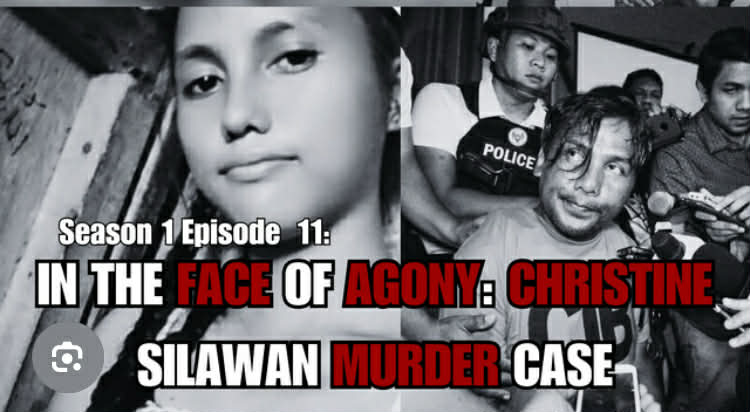
This and other images for the articles appeared in Facebook posts.
PACHICO A. SEARES
Feb. 25, 2026
[First published in News+One, SunStar of April 1, 2019]
“Yung nakapatay ng bata, ni-release (ng prosecutor). Tinawagan ko yun. Sabi ko, i-recall mo yung desisyon. Have the guy rearrested. Piskal ako.” –President Duterte, in a speech in Cotabato, March 26, 2019
OTHER presidents in the past must have also intervened in the administration of justice. After all, prosecutors or fiscals, as they used to be called, are administratively under the justice secretary, who is under the President and a member of the Cabinet.
The difference is that obviously past presidents didn’t talk directly with prosecutors. An aide like Bong Go gives the message to the justice chief, who relays it to the head prosecutor in Lapu-Lapu, who orders the assistant prosecutor handling the case.
The difference is that clearly past presidents didn’t tell the nation in a public speech that they reversed the order of a prosecutor by calling him up on the phone.
Unseemly at best
It may not be a crime, but it would look unseemly for the highest official of the land to reverse the decision of an assistant prosecutor. Checks on erroneous rulings are provided by the chief prosecutor, regional prosecutor, the justice secretary and the courts.
Assistant Prosecutor Ruso Zaragoza must have been stupefied and terrified, being placed on the horn of a big-ticket dilemma. How could he reverse his order, approved by his chief and announced to the world, with no facts and law supporting the turnaround?
President’s arguments
Zaragosa couldn’t use the President’s arguments, namely: (1) he was a fiscal before he became mayor, congressman and president; and (2) “hot pursuit” in “modern” times, cannot be effected in 24 hours and when the suspect uses a plane. The law and the facts as well as Supreme Court decisions all back Zaragosa’s ruling. Yet there was the President, the boss of bosses, telling him to “recall” his order.
Zaragoza had already stopped in the inquest proceeding and the Department of Social Welfare and Development (DSWD) released the 17-year-old former boyfriend of the victim, 16-year-old Christine Silawan, whose gruesome murder on a vacant lot in Lapu-Lapu last March 10 or 11 shook Cebu and the rest of the nation. The prosecutor was conducting a preliminary investigation and the National Bureau of Investigation (NBI) filed or was about to file a motion for reconsideration with the prosecutor’s office when the President called.
Protective custody
Zaragoza and the boy’s lawyer, Vincent Isles, convinced the boy’s mother that the boy would be safer if he were in protective custody. (Repetitive use of “boy” is preferable to the use of CICL or “child in conflict with the law.” He is no longer a “person of interest”; he is effectively a “suspect” but he is not called that, not until he turns 18. Politically correct words can be annoying.)
The mother’s fear about her child being targeted by extreme sympathizers of Christine must have prompted her to agree. The boy’s lawyer also didn’t want to offend the President. Isles explained Duterte’s action, saying he must not have read the whole case and must have been “misadvised,” misinformed about the real situation.
Status quo was restored. The boy was back at the care center in Lapu-Lapu last March 21, less than five days after he was ordered freed by the prosecutor. But Zaragoza showed concern for the law and the image of his office by saying repeatedly it was not a “rearrest” and his ruling has not been reversed.
Weight of evidence
A government functionary was able to fix the problem created by the President’s publicized order.
Isles was right about that order being based on inadequate facts. What he didn’t say was that it did not cure whatever flaw or lack in the case built up by law enforcers.
Taking back the former b.f. of the victim into custody, protective and voluntary or otherwise, did not change the weight of evidence. NBI and police may need more to make the charges stick, not just with the prosecutor but, more importantly, with the court.
A concerned public, instructed by the Ella Joy Pique murder in recent memory, wants to be sure this time that the law enforcers got their man, er, boy.